AR crowdsourcing: putting citizens at the centre of city design
- Public consultation on city design is mostly broken — a thin slice of opinions, delivered as words, not usable decisions.
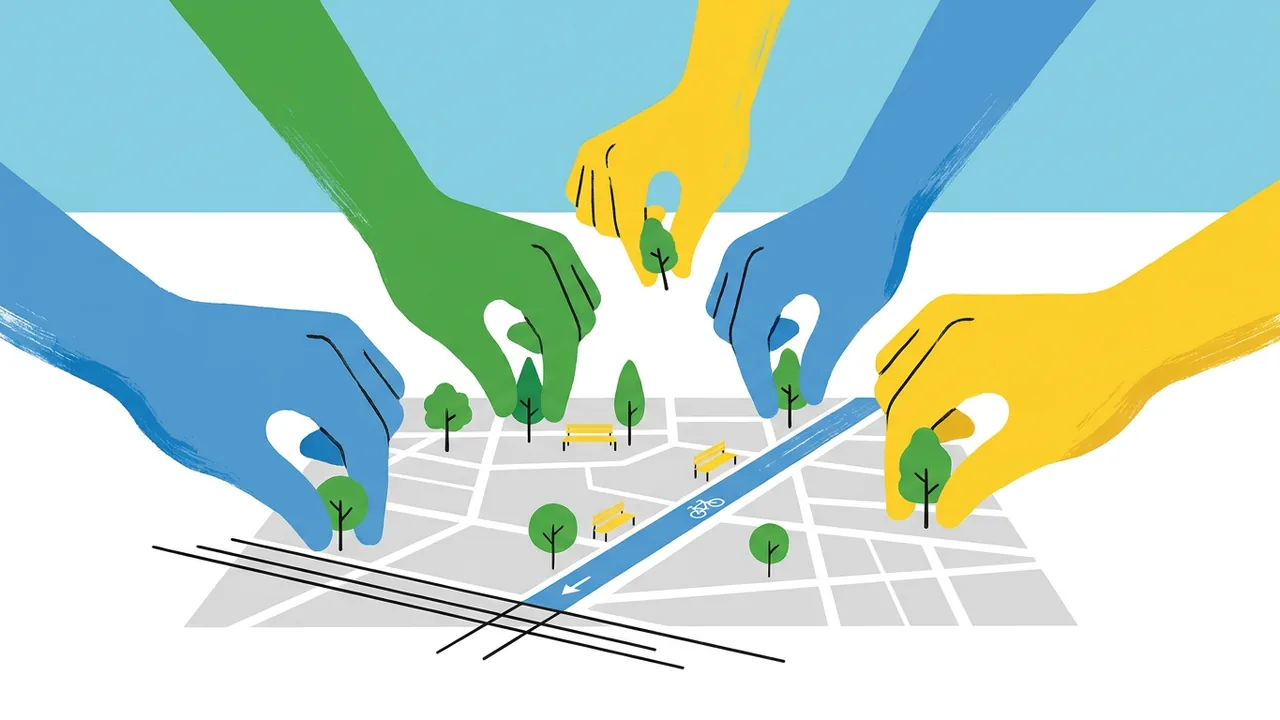
- AR lets residents place trees, benches and bike lanes in their own street, at full scale.
- Those placements become data planners can actually read — participation that improves both the result and its legitimacy.
Public consultation about city design is mostly broken. A plan goes on display, a notice appears, a handful of people attend a meeting in a community hall, and a few comment cards come back. The output is a thin slice of opinion from whoever had a free Tuesday evening — and it arrives as words, not as decisions a planner can actually use.
Augmented reality offers a different deal. What if residents could stand on their own street and place the change themselves — a tree here, a bench there, a bike lane along this edge — and see it anchored to the real world at full scale?
From opinions to decisions
This is the core idea behind the AR Crowdsourcing project: a universal AR app that lets anyone position simple urban elements — trees, benches, bins, basic infrastructure — onto the real environment around them. Instead of asking “do you like this proposal?”, it asks “what would you put here?” and records the answer as a precise, located choice.
That shift — from opinion to located decision — is what makes the data useful. A planner doesn’t get a pile of comments; they get a crowdsourced map of what residents actually want, where they want it.
How it works
- Place. Residents drop digital infrastructure as holograms onto the real world, at city scale, through their phone.
- Track. The system stores those choices anonymously and analyses them in aggregate — patterns, not individuals.
- Report. The output is a set of recommendations for the planning process, grounded in what the community proposed rather than what a single firm assumed.
The expert doesn’t disappear. The architect’s spatial judgement combines with thousands of small, located decisions from the people who’ll actually live there.
Seeing what isn’t there yet
AR’s real magic in a civic context is that it lets people see what doesn’t exist yet. Imagine a tree your whole courtyard could chip in for: on your phone it appears in place, but only half-rendered — because the neighbourhood has only raised half the money. You add a little, and it fills in more. Suddenly an abstract budget line becomes a thing you can see growing in your own yard. That’s a far more powerful invitation to participate than a notice on a lamp-post.
Make it a game, not a form
Here’s the honest problem: influencing your own city usually means colliding with bureaucracy, and bureaucracy is boring by design. Most people simply opt out. This is where a light layer of gamification earns its place — and I don’t mean a cartoon character jumping around. I mean small elements that make the process itself more engaging: a placement you can see, a contribution that visibly moves something, a choice that registers.
The deeper principle underneath is a tight feedback loop. The faster my actions and wishes come back to me — the faster the city “hears” me and I can see the result — the more comfortable I am taking part, and the more I trust the place. Slow, invisible feedback kills participation; fast, visible feedback creates it.
Keeping the city’s digital twin alive
Many cities now maintain a digital twin — a 3D copy of themselves used to plan and decide. The catch is freshness. A twin that’s rebuilt once a year is already wrong in a fast-moving city, especially at street level — the ground floors, the bit ordinary people actually live with. The fix is to let citizens help keep it current: the same AR placements people make can feed back as data that updates the twin, turning residents into a living sensor network for their own city. Participation and accuracy become the same act.
Why it matters
Cities built with their residents get used, maintained, and loved in a way that top-down plans rarely are. Participation isn’t a nice-to-have box to tick — it’s a long-term driver of whether a place works. AR makes participation concrete and spatial instead of abstract and verbal, and it scales to a whole neighbourhood instead of one church hall.
It’s another case of spatial intelligence in the real world: software that understands a place well enough to let ordinary people design within it, and turns the result into something decision-makers can act on.
The cautions
Two things keep it honest. First, privacy: collect located choices, not personal movement profiles. Second, representativeness — make the tool genuinely easy and accessible, or you simply digitise the same loud minority. Done well, AR crowdsourcing widens who gets a say. Done carelessly, it just gives the confident a slicker megaphone.
Working on a civic, urban, or public-space project?
I advise teams on participatory and spatial approaches to design. Book a 1:1 call.
Book a call →